

There is a familiar rhythm to the way the corporate media and liberal politicians in D.C. talk about AI, and if you lived through two decades of climate narrative politics, you already know the beat. First comes the prophecy of imminent catastrophe. Then comes the insistence that only sweeping government action can save us. Then comes the curious detail that the catastrophe keeps failing to arrive on schedule, even as the demands for control grow louder. We have seen this movie before, and the only thing that has changed is the main character in the script.
Special Free Offer for The Dossier readers from our friends at Upside:
Earn an additional 25¢ per gallon at your next fill up!
Upside is a free mobile app that puts real cash back in your pocket on everyday spending like gas, groceries, and dining out. Just claim an offer, pay with your linked card, and watch the cash back land straight in your bank account or PayPal—no points, no gimmicks, just money.

Consider Bernie Sanders, who has become the loudest political voice on AI’s supposed jobs apocalypse. In October, the senator’s HELP Committee released a report carrying the subtle title warning that AI and automation “could destroy nearly 100 million U.S. jobs in a decade.” He has since called for breaking up OpenAI, told an interviewer the technology is “like a meteor coming,” and alongside Rep. Alexandria Ocasio-Cortez (D-NY), introduced legislation for a federal moratorium on new AI data centers until the government can install the proper “safeguards.” The policy wishlist arrived fully formed with demands such as a robot tax and a moratorium on technological innovation all citing a potential crisis, but no actual data-backed causes.

AI doomerism is the climate template, reproduced almost line for line. Even decades before I was born, Americans were told that catastrophe was always ten years out, that the science was settled, that the only debate left was how much state power to hand over, and how quickly. The predictions, like ice-free Arctics, drowned coastal cities, climate refugees by the hundreds of millions—came with confident dates attached. Notably, the dates passed, but the demands did not recede. The alarmists simply found more nonsensical narratives and more new deadlines.
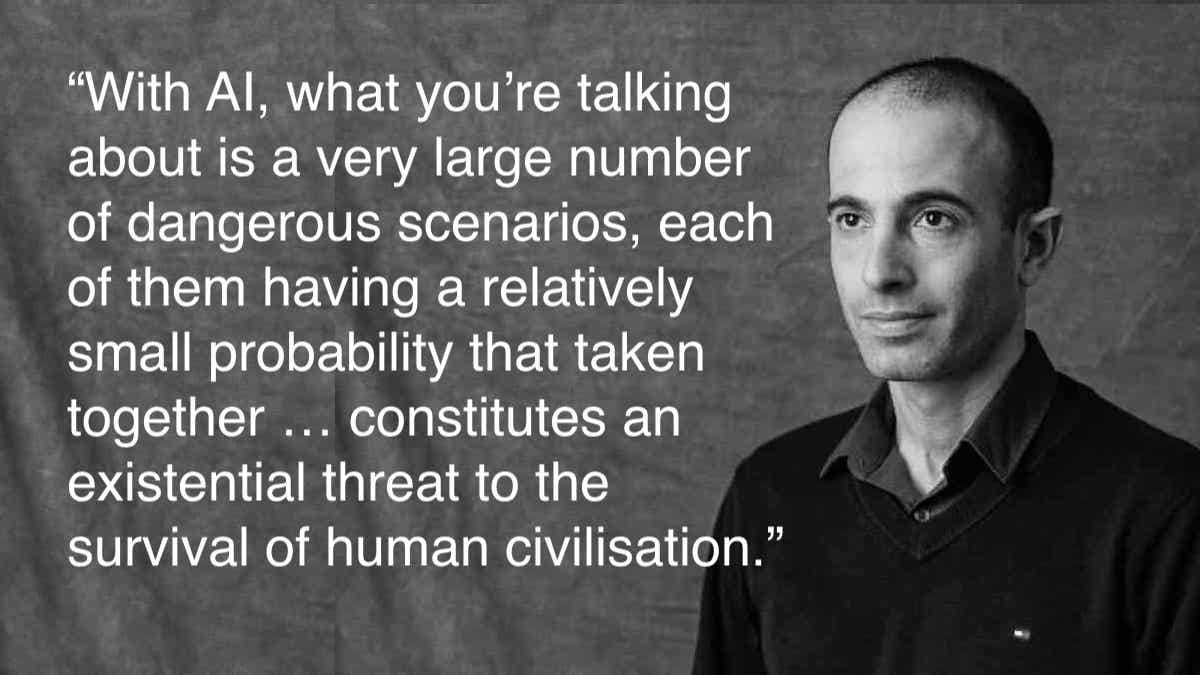
Consider Bill McKibben, who wrote The End of Nature in 1989, arguably the founding text of modern climate alarm, and who in 2023 signed the Center for AI Safety’s statement declaring that “mitigating the risk of extinction from AI should be a global priority.” McKibben didn’t so much change subjects as expand his catalog of apocalypses, explicitly citing climate as the precedent: “Given our failure to heed the early warnings about climate change 35 years ago, it feels to me as if it would be smart to actually think this one through,” he said of AI. Yuval Noah Harari, the Davos circuit’s favorite prophet, has likewise spent years warning of ecological collapse and now insists AI is as threatening as climate change and nuclear war, an “alien species” that could end us.
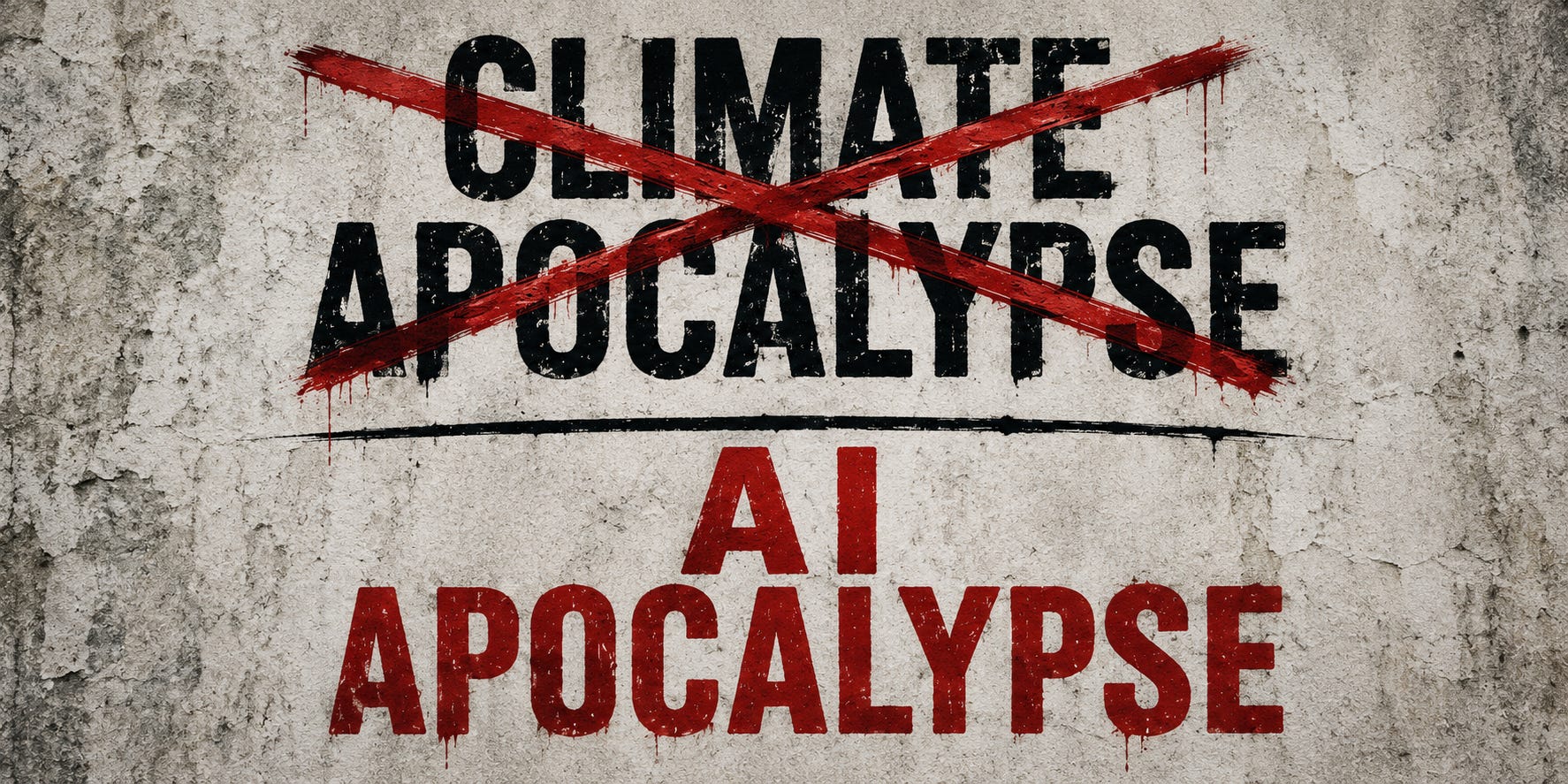
The institutional overlap is not exactly subtle. The Bulletin of the Atomic Scientists, keeper of the Doomsday Clock, spent years citing climate change as a primary reason humanity was creeping toward midnight. In January it set the clock at 85 seconds to midnight, its closest ever, and folded artificial intelligence directly into the same basket of “existential threats” alongside nuclear war and climate change. The same body, the same apocalyptic framing, the same call for “international guidelines” and “multilateral agreements.” The Bulletin’s own writers have made the connection explicit, arguing that the world’s “collective failure to heed climate warnings” is a lesson that must now be applied to AI. The threat is interchangeable and the remedy is always centralized control over society.
What makes the AI version especially worth scrutinizing is that, unlike long-range climate modeling, the central claim is testable right now. Sanders says AI is throwing millions onto the street. So is it? The data says no.
The Yale Budget Lab, hardly a den of right-wing skeptics, has been tracking AI’s labor-market footprint since the first version of ChatGPT’s release. Its current conclusion: while anxiety is widespread, the effect on today’s labor market “remains largely speculative.” The picture that emerges, the researchers wrote, “is one that largely reflects stability, not major disruption at an economy-wide level.” They found no clear rise in AI-task exposure among the unemployed and no lengthening of joblessness in the most exposed occupations.
Anthropic, which nobody in their right mind can claim as a hyper accelerationist outfit, published research in March finding “no systematic increase in unemployment for highly exposed workers since late 2022.” Goldman Sachs projects that any AI unemployment effect will be transitory and no larger than half a percentage point above trend. Every major institutional forecast, from the IMF, to McKinsey, to the BLS shows net positive job creation at the macro level over the medium term. When Amazon cut tens of thousands of corporate roles, even Amazon attributed the move to slashing bureaucracy, not robots or AI. The Yale researchers raised the pointed question of “AI-washing,” which amounts to companies blaming innovation to justify necessary cost-cutting from overhiring in the post covid era.
None of this means AI and the sweeping technological innovation that will come with it is consequence-free. Entry-level hiring in some fields, like junior software roles, has clearly softened. But the most plausible explanation is not that the machines have already replaced those workers; it is that hiring managers are making decisions based on the very narrative that politicians like Bernie Sanders are selling. A Reuters/Ipsos poll found 71 percent of Americans fear permanent job loss to AI, and firms are responding to that expectation rather than to a measured productivity reality. Goldman Sachs describes employers “integrating AI to avoid adding headcount” rather than firing anyone. The AI doomer prophecy is self-fulfilling: the alarm itself, like the climate narrative, creates a certain corporate standard even if it’s vidence free, and it results in the cooling of the hiring pipeline. The scale back then gets cited as proof the alarm was warranted.
AI doomerism is a powerful narrative, and pursuing some kind of sweeping federal moratorium based on a narrative, and not evidence, would entrench that narrative and make the prophecy come to life.
The alarmist method does not actually require evidence, because the prophecy is structured to be unfalsifiable. If layoffs come, that proves the danger. If they don’t, that proves we caught it just in time, or that the catastrophe is merely delayed, lurking past the next horizon. The climate narrative skirmishes taught the activist class that a sufficiently frightening and sufficiently distant prediction can power an entire political program indefinitely, immune to the inconvenience of being checked against reality.
AI may well reshape the economy. But “take it seriously” and “grant the government emergency powers over a multi trillion-dollar industry on the strength of predictions data already contradict” are two very separate paths forward.
Two very different things. One an obvious lie, one already being used as a tool to warp young minds. Who is held responsible when AI lies, which it frequently does, who can we take to court?
A/i is kind of doomy. I mean it's dark, soulless, unfeeling, uncaring, inhuman, calculating, thoughtless and heartless.