

The AI executives racing to build the most advanced models are also racing to convince Washington that the whole of American society will soon need a monthly government check to survive their creation. Anthropic CEO Dario Amodei used 20,000 words in his recent essay to warn that AI will function as a “general labor substitute” and to float universal basic income (UBI) as a remedy. His cofounder Chris Olah, speaking from the Vatican alongside Pope Leo XIV, declared there is “a real possibility that AI will displace human labor at a very large scale,” and that supporting those displaced “will be a moral imperative of historic proportions.” OpenAI’s Sam Altman has been running UBI pilots for years, and he too has suggested that Washington should start writing checks.
This is being marketed as compassionate foresight. It’s not. A UBI social welfare program would be the most costly and most destructive economic and societal initiative in American history, and one we should refuse on principle long before Congress could potentially entertain this path of ruin.


Let’s start with the foundational claim, that AI will produce permanent mass unemployment requiring permanent income replacement. There is no serious evidence this is happening. Anthropic’s own labor-market research has found no increase in unemployment in the occupations most exposed to AI. National unemployment sits at 4.3 percent. Software engineering job listings recently hit a three-year high. The Doomer narrative is rhetorical, not empirical, and notably, it is being pushed hardest by the people who stand to gain most from convincing the public that they need a massive regulatory and competitive moat to protect their technology.
History demolishes the displacement thesis. In 1900, roughly 40 percent of American workers were employed on farms. By 1980, that figure was 3.4 percent. Tractors, fertilizers, and irrigation collapsed agricultural labor demand by an order of magnitude. The result was not mass destitution. There was a rise of entire industries that the visionaries of 1900 could not have named: aviation, electronics, software, telecommunications, biotech. Each new wave of automation freed human capital to flow toward problems we had not previously had the bandwidth to solve. The Luddite fallacy is baed on a left wing assumption that the quantity of labor demanded is fixed, and it has been refuted in every generation. Somehow, every generation of central planners forgets this lesson.

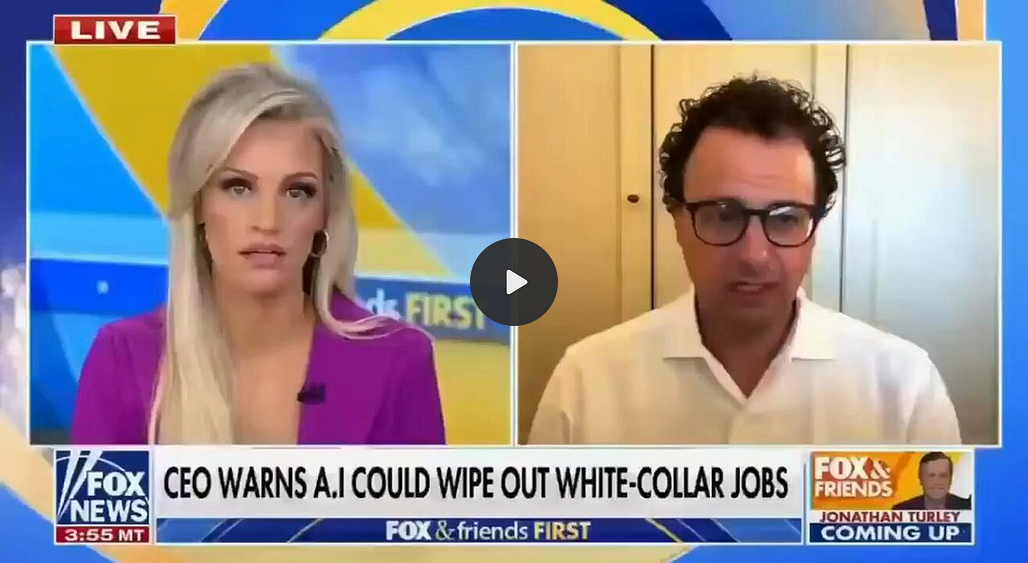
Even granting the Doomers and Effective Altruists their worst-case scenario, a rough transitional decade in which displaced workers struggle to reskill, UBI is the worst available answer. It is not, as its boosters claim, a clever technocratic patch. It is straightforward socialist redistribution scheme. I know, UBI advocates get really upset when you properly label this idea as socialism. But yes, it’s socialism.
A mere $1,000 monthly payment to every American carries a price tag of roughly $4 trillion per year, equivalent to half the entire federal budget. There is no honest path to that revenue that does not involve a permanent and dramatic expansion of state power, federal taxation, and central economic planning. Once established, no such program has ever shrunk. UBI is not a bridge; it is a foundation, and the building that gets erected on top of it is bigger government in perpetuity. And it’s not like other government programs will be shut down to make up for the budget hole that UBI creates. It just never works that way.
The pilot data is incredibly damning. Trials in the United States have found that recipients work less and enjoy more leisure, but show little evidence of better entrepreneurship or lasting mental-health improvement. The promised burst of small-business creation and creative renaissance does not materialize. What materializes instead is that people consume the subsidy and reduce their economic output.
That last point should worry us most, and here is where Anthropic cofounder Olah’s framing should be turned back on him. The strongest case against UBI is not fiscal but moral. Work is not merely how people pay rent. It is so critical to how they build identity, structure time, form community, and compose a meaningful life. Of course, this doesn’t mean that people should engage in work for the sake of working. There needs to be a purpose to that work.
The Doomers’ UBI proposal takes the worst pathology of post-industrial America and offers it to everyone as policy, and it is being pushed by the very firms whose products will allegedly necessitate it. It is not a moral imperative, but a moral inversion of historic proportions.
Also, UBI lets frontier AI companies socialize the costs of their disruption while continuing to privatize the upside. The American taxpayer would be forced to absorb the workforce displacement. It is a remarkably tidy and economically beneficial arrangement for the people proposing it.
The honest response to AI’s potential labor-market effects is the opposite of what is being proposed. Instead of a UBI regime that fundamentally transforms America into a socialist nanny state, cut the regulations that block new industries from forming and get the federal boot off countless American industries. Free people and market forces will always adapt to change better than some massive, society immolating UBI program.
One need only look at the damage wrought upon Black America’s values and economic wherewithal since the experiment in socialism that took off in the 1960s with LBJ and parentage from FDR.
No one seems to be asking what seems to me an obvious question: "If no one is working, where does the government get the revenue to issue these subsidy checks?" One answer might be that the government confiscates the means of production and distributes the companies' profits.... Oh, wait, that sounds familiar....