

Washington keeps telling itself a very relaxing story about China and artificial intelligence, and it goes like this: China’s AI is not really China’s at all. They merely smuggled in the powerful American components that AI runs on, they stole the ideas from American companies, and so we have nothing to fear as long as we ban a few more things. The story is comforting to fellow China hawks and those of us who believe in American excellence, but it is largely false. On the AI front, China has caught up to us in a big way, and it is now a serious rival in the most important technology of our lifetime.
China has about a million people working on AI around the clock, while America has a fraction of that number, and yet, in D.C., some remain insistent on a plan to wall off China, which again, is not stopping China from catching up. Instead of just coping and banning, we can wake up and compete. America has the most robust markets and the best tech companies, and D.C. needs to focus on what makes us the best instead of deploying a strategy entirely based on botched attempts to handicap our adversary.
Why is this “stolen AI” story so popular in D.C.? Because it does two jobs at once. The first is to make Chinese AI look like stolen subpar junk, similar to a piece of military hardware or a knockoff EV, so that America can ban it instead of building something better. The second is to let us cognitively relax, because a country or company that only ever copies can never get ahead of the one making the real thing.
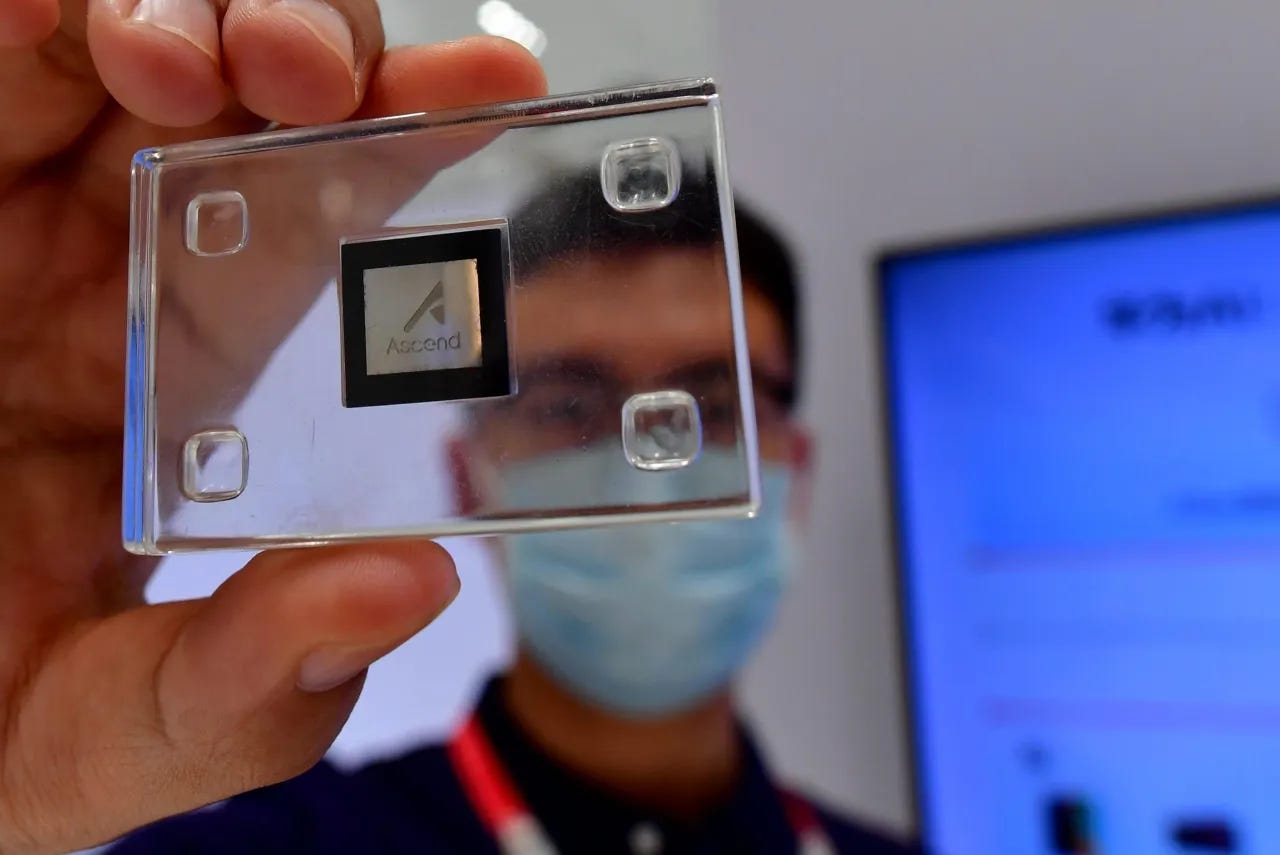
Start with the chips, because that is where the “they smuggled everything” idea is supposed to live. To train an AI model, you normally need thousands of specialized chips working together. The most powerful ones are American, and the U.S. has banned selling them to China, so the accusation from D.C. is that China just sneaks ours in in droves. But now, China says its newest AI models were trained on chips it built itself, made mostly by Huawei. That is believable to the honest observer, because Beijing has been prioritizing it as a national goal for years. One Chinese model that is getting a lot of hype in Silicon Valley, GLM-5.2, which is fast becoming good enough to rival the best American ones at writing code, was reportedly trained on about a hundred thousand Huawei chips with few if any American components involved. Another popular Chinese model, DeepSeek’s V4, was built from the start to run on Huawei chips too.
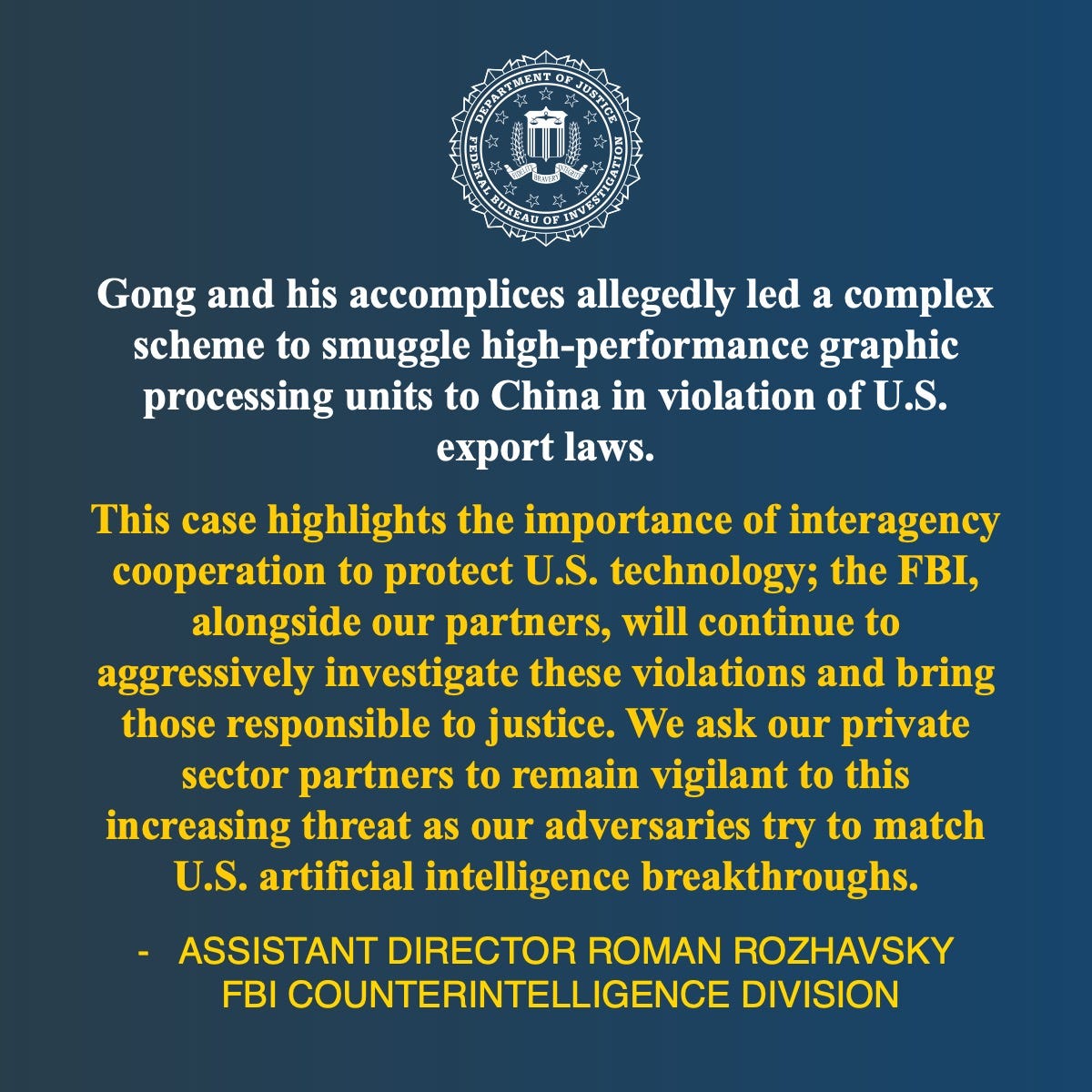
This doesn’t mean that China is engaged in zero nefarious behavior in the AI race. There are notable the criminal cases, and here the Department of Justice has indeed been busy, shutting down a $160 million smuggling network and separately charging a group that moved roughly $3.89 million worth of gear amounting to a few hundred chips. These are real prosecutions and real crimes, and yet when you set them against the global AI market, they amount to a rounding error. These reports amount to not even a small fraction of what it takes to build a tier one national AI program.
Now the “they stole our ideas” part. The main accusation is via distillation. Basically, an AI system learns by pulling the data from the answers of a smarter AI. In this scenario, we are talking about models like Anthropic’s Claude or OpenAI’s ChatGPT. It’s akin to a student studying a smarter classmate’s work to learn how they think. Yet in AI, this is an everyday practice among rival American and foreign companies. Anthropic admits, in the same report where it accuses China of bootlegging their product, that distillation is legitimate and used all over the industry.
The biggest hole in the “they just copy us” idea is what it forces you to believe about people. China produces close to half of the world’s very best AI engineers. To say all they can do is copy is to claim that hundreds of thousands of engineers, some of whom were trained in America, are mere robots who cannot think for themselves. We are just feeling good and coping more by disrespecting our rivals as stupid and incapable of original innovation.
And the plan built on that mistake, which was mostly spawned out of the Biden White House, is failing right in front of us. The export bans were supposed to choke off China. Instead, China is now turning American chips away at its own border on purpose, to push its companies onto Chinese chips and get better at making them. A recent Brookings report shows says the bans are speeding up China’s chip industry in the long run. The Biden Administration swung the ban hammer expecting China to come begging, and it instead walked away. Chinese companies that were hooked on American technology are becoming self sufficient.
Historically speaking, you never win a technology race by hiding the technology and banning your way to victory. You win by making your technology the thing the whole world uses, so that even your rivals build on top of it and speak your language. We should want the whole world built on American technology because it allows U.S. companies to become extensions of American power and influence.
The AI race with China presents a pretty simple binary, given that the U.S. and China are the only major players in the race: A foreign AI company that runs on American AI components is a win for America. A foreign AI company that runs on Chinese AI components is a loss for America. American tech companies, albeit imperfect instruments of American power, are one of the most powerful weapons this country has, and we are blunting them out of fear. America needs to stop coping and pretending, and start competing. Our Chinese rival is real and capable, their engineers are real and capable, and the way to win is to out compete China instead of spinning tales about how theyr’e just stealing all of our stuff.
We are watching some regulatory delays play out from the White House with Anthropic's Mythos and now OpenAI's GPT-5.6. The instinct is sound, and a brief, serious cybersecurity check before making them public is a matter of simple prudence. But prudence has a clock on it and a review that drags on can fast transform into the ban hammer again. The longer an American model waits in a government queue gives Chinese models extra time to ship to the world without delay. We can proceed with righteous caution, but this shouldn’t turn into an exercise involving overwhelming bureaucratic red tape.
Of course, none of this would matter so much if America and China were just two teams trading places on a leaderboard. The stakes here are about what kind of world the most powerful technology of our time gets built to serve. China is a totalitarian state which has created a system that exists to preserve the Party. The individual exists to serve the state, and an AI shaped by that worldview will carry its fingerprints into everything it touches. Our system is surely imperfect, but in America, many of us still believe that ordinary people are capable of governing themselves and deserve the freedom to flourish on their own terms, and American technology has a much better chance of continuing to represent those values.
Remember when Biden said China was not our enemy??
All I’ve seen from you lately is pro-AI propaganda. You’re not even bothering to examine both sides of the debate. I’ll pass.