

America cannot become the world’s undisputed super intelligence (SI) superpower if we refuse to build the power needed to sustain it.
All too often, we treat reliable electricity as something that will magically appear as a result of investors piling money into super intelligence chips and data centers.
To achieve President Trump’s vision of American energy and American SI dominance, we need to achieve an enormous expansion of reliable electricity generation. Our chief rival in China has no shortage of power. Nuclear power should be central to the effort to bridge the gap.
Scrolling through X today, I discovered a startup’s promising new proposal in eastern Kentucky, and it offers a powerful glimpse of what building at the necessary scale could mean for America’s future.
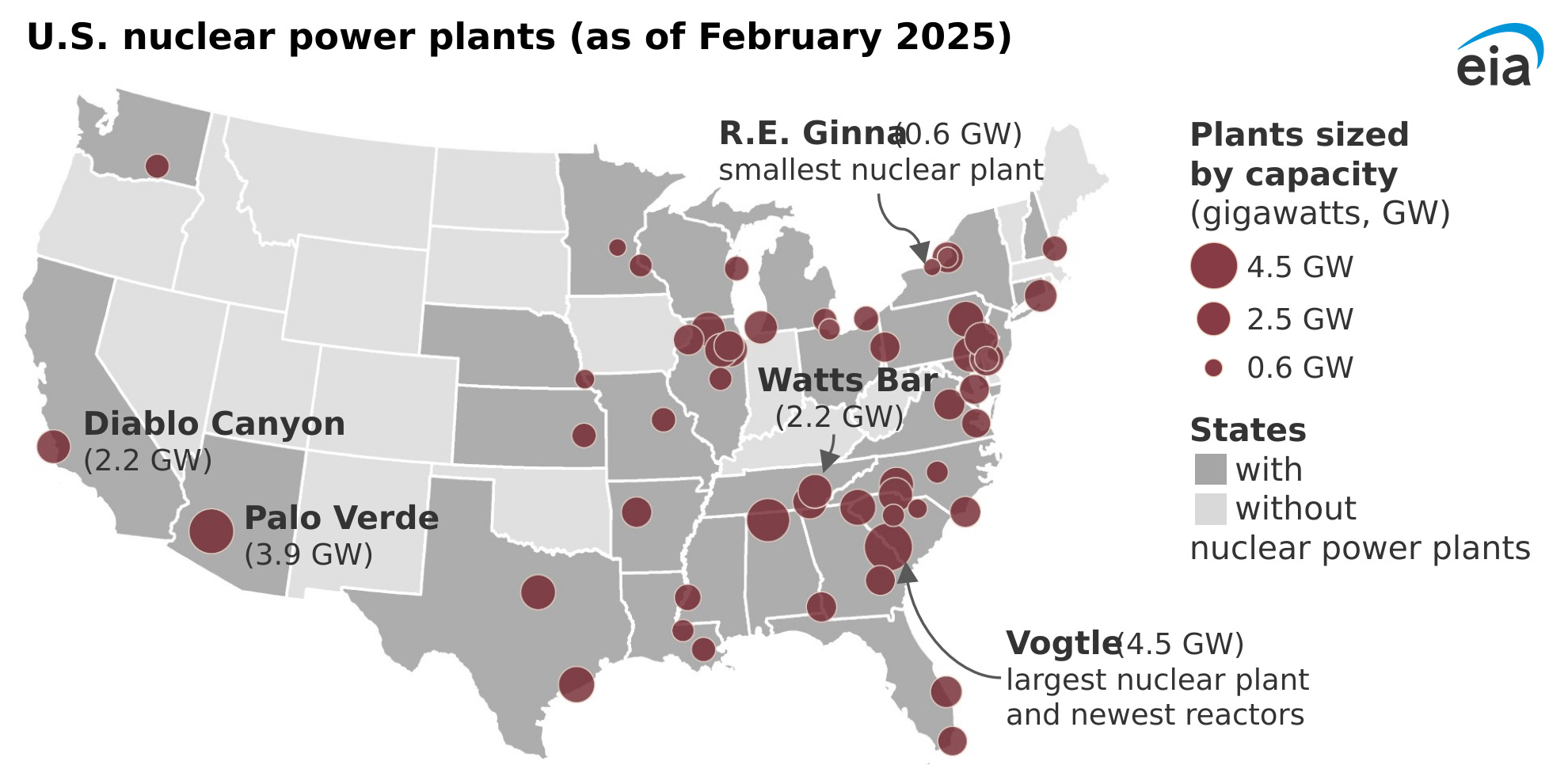
The Nuclear Company has announced Prosperity One, a proposed campus along the Ohio River in Lewis County, Kentucky that could accommodate six Westinghouse AP1000 reactors, producing approximately 6.6 gigawatts of electricity. If it comes to fruition, the campus would serve as the largest nuclear site in the United States. The U.S. nuclear fleet currently has a total net generating capacity of about 97 gigawatts, according to the U.S. Energy Information Administration.

America needs an energy policy that makes projects of this size possible, and the president has already established that he has bold plans for nuclear energy. His nuclear executive orders call for expanding American nuclear capacity from roughly 100 gigawatts to 400 gigawatts by 2050, alongside a goal of having ten new large reactors under construction by 2030.
Meeting these targets will require more than just booting back up outdated shuttered plants or improving the current fleet. We need to build new reactors at industrial scale, and unsurprisingly, nuclear has become one of the hottest spaces in American entrepreneurism today.
Prosperity One is especially interesting because it proposes using an established reactor technology rather than waiting for a future breakthrough. While theoretical future nuclear ambitions generate lots of intrigue from venture capitalists in the Bay Area, America can’t base our nuclear strategy on theoretical prospects. Seventeen AP1000 reactors are already operating or under construction across the world. The Nuclear Company’s broader strategy emphasizes standardized engineering and repeat construction: design once, build many.
For super intelligence, the case is rather straightforward. American technological infrastructure needs dependable electricity right now. Nuclear delivers enormous quantities of power around the clock without depending on whether the sun is shining or the wind is blowing. And it mitigates many of the concerns that arise when data centers are forced to install turbines to supply power to hyperscale data centers.
The White House has made clear that Americans should not be asked to accept higher household bills as the price of innovation. We just need to meet the demand with more supply.
What I like about the new proposal is that it wants to deploy the campus deep in coal country. It’s a place where solid jobs are often in short supply. The employment potential is substantial. Georgia Power reported that construction of two new reactors employed some 9,000 people. These large-reactor projects can significantly bolster economic value to distressed regions throughout the country.
For too long, the nuclear industry has been in a permanent state of paralysis. Despite the technology being both safe and incredibly efficient, Washington hasn’t done its part to let American builders strengthen our innovative capacity in the 21st century.
The significance of this project goes well beyond just The Nuclear Company but it serves as perhaps the largest manifestation of President Trump’s energy and super intelligence agenda. If we want to lead the super intelligence era, we need to deploy the buildout necessary to scale it.
Get the nuclear regulatory agencies to rewrite Carter's obstructionist rules and you'll see a Nuclear Renaissance, but we will not scale up until then.
Yep. We need more juice and not just for this. Sitting in the interior West, I am sick of being colonized by the coasts who want power but won't let it develop in their jurisdictions. Looking at the map, it appears that the South has an even more powerful grievance.