

I’ll admit it. Not long ago, I was the person in the room sighing at the very mention of “artificial intelligence,” which I considered a fancy but somewhat indistinguishable replacement for the word technology.
Every breathless headline about AI felt like a tech industry sales hype pitch dressed up as valuable information. The demos were impressive in a parlor-trick kind of way, but the outputs were hollow. I perceived the first iterations of an emerging technology as confident-sounding nonsense that had clearly never been stress-tested against reality. The word “revolutionary” got thrown around so freely it lost all meaning. I filed AI alongside the metaverse, “crypto,” and NFTs: another Silicon Valley fever dream burning through billions in venture capital before quietly disappearing.
I was wrong. And I think a lot of people who share my former skepticism are going to have to reckon with that same conclusion sooner than they expect. The techno-optimists are right.
Techno-optimism is the view that technological progress, allowed to develop and scale freely, is a net positive force for human civilization. In a sense, it is a defense of capitalism. It is the belief that innovation solves more problems than it creates and that the right response to a powerful new tool like AI is to master it, not fear it. It is a distinctly American disposition, and for a while, I had talked myself out of it. The term has roots in the post World War II world, but in its modern, prominent form is most associated with venture capitalist Marc Andreessen. In October 2023, Andreessen posted an essay called "The Techno-Optimist Manifesto," which argued that technological advancement is the primary driver of human progress and well-being. I highly recommend reading Andreessen’s take on the subjective matter with an open mind.
What kept me (and keeps many critics) in the skeptic camp was a poor mindset, one that is best captured by a word that has become something of a cultural shorthand: slop. The term refers to the low-quality, derivative content that AI systems can generate at infinite, industrial scale. You’ve seen the generic blog posts, the low quality robotic copy, and the AI generated imagery and videos. The criticism isn’t entirely wrong. Slop exists. It is genuinely a problem for certain corners of the internet.
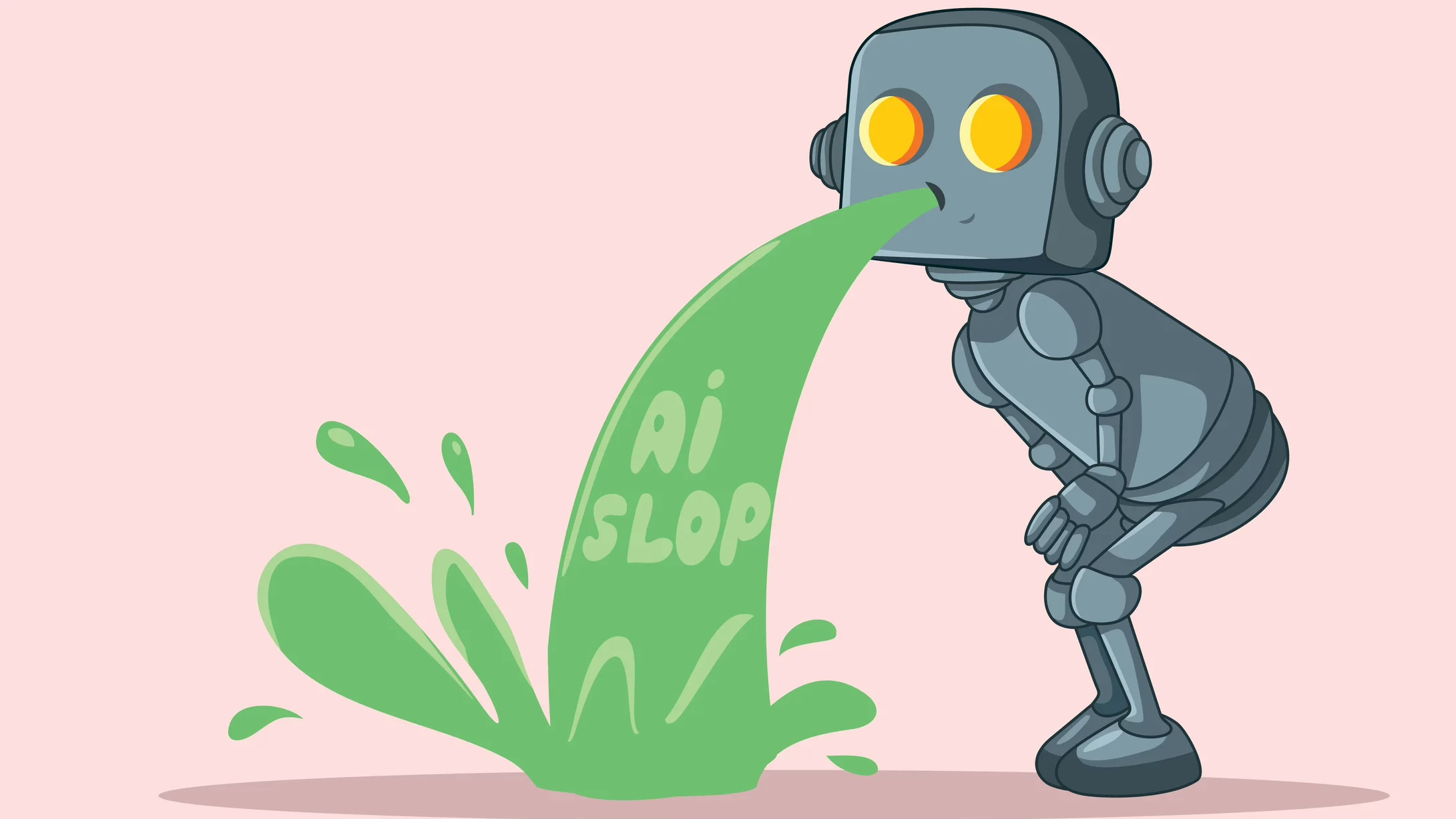
But “slop” has become a rhetorical bludgeon. It’s become a way to dismiss an entire technological revolution by pointing at its worst outputs. It’s something of a mind trick to blackpill the public, and it serves as a smokescreen for the countless applications that are changing the world with AI. It’s the equivalent of judging the automobile by the first car accidents. Or judging a company like SpaceX merely by its early rocket failures. Every transformative technology frequently produces lackluster outputs in its emerging stages. The question worth asking isn’t whether AI can be used badly, but whether it can be used well. And increasingly, the answer is an unambiguous yes.
The turning point for me wasn’t a single moment. As an entrepreneur, I started incorporating AI into my actual workflow, not as a “slop” novelty, but as a serious instrument. I learned how to prompt more and more effectively. I read the books and took the time to piece together an understanding of how the technology works. Research that once took hours, or even days, began taking minutes. Design work that required thousand of dollars, dozens of human contract hours, and countless iterations came back sharper and infinitely faster. Strategic problems I’d normally think about in isolation became collaborative exercises with AI copilots. AI hasn’t replaced my judgment, and using it in any kind of fashion would be a tremendously detrimental exercise. Instead, it has acted as a tool to amplify by output. And as I continue to learn more about the fundamental principles of these instruments, along with the technological progress they are making, they will become more and more useful over time.
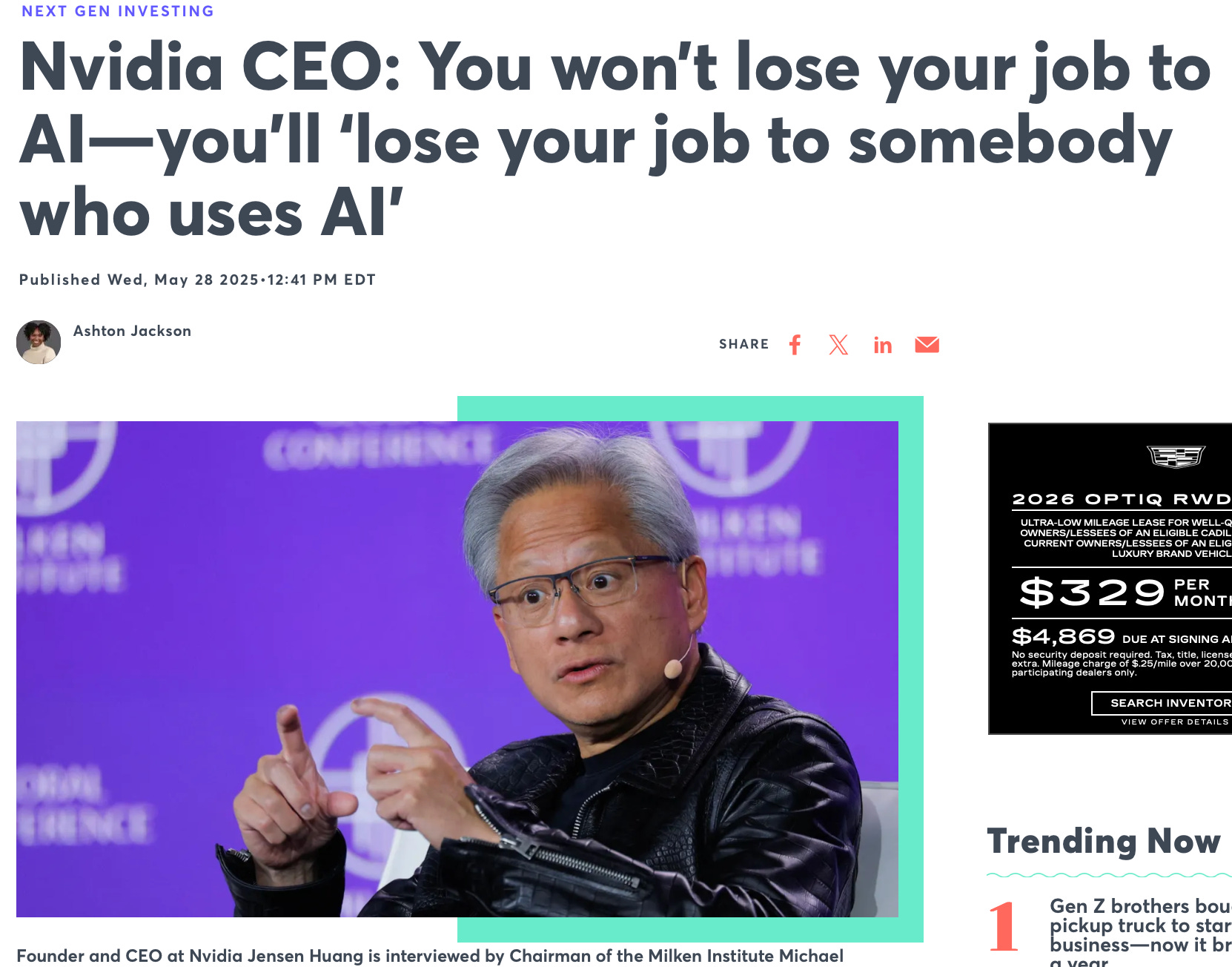
That distinction matters enormously and gets lost in the public debate. AI is not a replacement for human intelligence. Instead, it is a force multiplier for it. The thoughtful entrepreneur who adopts it doesn’t become redundant. AI becomes something of his superpower, and he becomes dramatically more capable than the competitor who refuses to put the work in to master a novel technology. The same logic extends to lawyers, doctors, analysts, researchers, and virtually every knowledge worker in between. We are not watching machines displace human ambition. As Nvidia founder and CEO Jensen Huang explained at a recent conference: “You won’t lose your job to AI. You will lose your job to somebody who uses AI” better than you do.
The upheavel is real, but so is the opportunity.
None of this means the transition from 0 to 1 when integrating a revolutionary technology will be painless. It won’t be. AI is going to restructure entire industries, and some of that restructuring will be genuinely disruptive for the people caught in its path. Certain jobs will shrink. Certain business models built on labor-intensive processes will be exposed as obsolete. Pretending otherwise would be dishonest. I’m sure it sucked when automobiles took market share from the horse carriage business, and when machine computers took over from people who manually computed calculations.
But disruption and destruction are not synonyms. The industrial revolution, after all, did not impoverish humanity, it built the modern world. The internet did not hollow out commerce, it reinvented it on a scale no one anticipated. In every comparable technological wave, the people who bet against the technology eventually lost, and the people who learned to use it eventually won. There is no reason to believe AI will be any different. History tells us that the AI Doomers — those who believe AI will destroy the job market and pose an existential threat to humanity — are wrong.
AI skepticism is a first world luxury that America cannot afford. China is not debating whether artificial intelligence is overhyped. Beijing is not writing think pieces about slop (unless as a means to empower leftist degrowthers in the United States). It is pouring massive state resources into AI development with a strategic clarity and urgency. The country that dominates AI will dominate our 21st century geopolitical competition, which extend to the economy, our military, intelligence apparatus, and capacity to project influence globally. American leadership in this technology is not guaranteed. It has to be built, defended, and reinforced by a culture that takes the tools seriously rather than sneering at them.
Let me be direct about something that I suspect resonates with a lot of conservatives and libertarians who share my journey: many of the people who built this technology hold worldviews I find deeply troubling. Much of the AI industry's leadership class is a peculiar ideological cocktail, full of progressive politics and transhumanist philosophy. Some of its most prominent figures speak openly with reckless abandon about accelerating toward a future that nobody elected them to engineer. But consider another historical parallel. J. Robert Oppenheimer, the father of the atomic bomb, wanted to hand nuclear technology over to the United Nations. He believed the weapon he helped build should be governed by an internationalist body with the power to constrain American sovereignty. His politics were, to put it charitably, not conservative. And yet the bomb he built, under the direction of a government that ultimately rejected his internationalist vision, deterred Soviet aggression and underwrote seven decades of American strategic dominance. The lesson is straightforward: you do not have to share an inventor's ideology to recognize the value of his invention.
Skepticism and suspicion is primarily useful when it remains open to evidence, and the evidence on AI’s productive potential is mounting fast. The choice in front of us isn’t between AI and some better, safer alternative. It’s between embracing a tool that rewards human initiative and ceding that advantage to those with fewer hesitations. The AI genie isn’t going back into the bottle. For entrepreneurs, for workers, for America as a whole, the path forward isn’t to complain about the slop. It’s to find the good and build something better with what we now have.
A lot of words building up and then debunking a straw man argument against "AI."
Nobody (or very few) opposed to "AI" deny how efficient it may prove to be, the ability it may have to aggregate datapoints and detect patterns, produce useful valuable output in a fraction of the time it takes current systems. That's a given, no serious person denies that; it's a freakin' computer, that's what computers do.
You share a truth that gets as close to the real peril of it in your piece, "Much of the AI industry's leadership class is a peculiar ideological cocktail, full of progressive politics and transhumanist philosophy. Some of its most prominent figures speak openly with reckless abandon about accelerating toward a future that nobody elected them to engineer." But then equate it with a non-sequitur about how the technology to split the atom didn't result in the world nuking itself to the Stone Age.
No, that's not the correct paradigm and threat to compare "AI' technology to. All those "AI" Data Centers are being built to process ALL the data that is currently gathered on us, every last bit of it that currently languishes without attention due to resource constraints becomes capable of real-time processing for everything everybody does. With algorithmic pattern identifiers to "measure" "risk," desirable traits, thoughts, propensity to have anti-authoritarian, skeptical ideas. Even dystopian "pre-crime" arrests straight out of Minority Report become possible, instituted, normalized. Only "AI" possesses the capability of making that happen. And ALL governments around the world are desirous of this. Collaboratively, not competitively, like splitting the atom was. Ironically, "AI" Data Centers deemed so important that they require building nuclear energy plants to power, once relegated to the "too dangerous" ash heap of history, The ability to monitor and control populations determined to be worth the investment and risk.
Worldwide Social Credit Industry - Infrastructure to Support Social Credit Systems Represents a $16.1 Billion Opportunity by 2026
https://www.businesswire.com/news/home/20211223005270/en/Worldwide-Social-Credit-Industry---Infrastructure-to-Support-Social-Credit-Systems-Represents-a-%2416.1-Billion-Opportunity-by-2026---ResearchAndMarkets.com
"The COVID-19 pandemic has facilitated substantial interest in citizen monitoring solutions
Infrastructure to support social credit systems represents a $16.1B global opportunity by 2026
Cameras and other optical equipment for social credit systems will reach $723M globally by 2026
Advanced computing will be used in conjunction with AI to provide nearly flawless identification and tracking
Various forms of biometrics will be used for identity verification as well as verifying the presence/location of people
Starting as tangential to public safety and homeland security, the social credit market becomes mainstream by 2026
Social credit systems represent the ability to identify (mostly people but also some "things") and track activities for purposes of grading behaviors and applying "social credit" scoring. A given grading/scoring methodology depends largely on social credit system objectives and metrics.
However, most systems will have socially acceptable behaviour at their core. This presents both a challenge and an opportunity as a combination of government, companies, and society as a whole must determine "good", "bad", and "marginal" behavior within the social credit market."
Omnipresent AI cameras will ensure good behavior, says Larry Ellison
https://arstechnica.com/information-technology/2024/09/omnipresent-ai-cameras-will-ensure-good-behavior-says-larry-ellison/
“Citizens will be on their best behavior because we are constantly recording and reporting everything that’s going on,” Ellison said, describing what he sees as the benefits from automated oversight from AI and automated alerts for when crime takes place. “We’re going to have supervision,” he continued. “Every police officer is going to be supervised at all times, and if there’s a problem, AI will report the problem and report it to the appropriate person.”
FF - The comparison to the atomic bomb does stand, however, in that both are either a tool for good or a weapon for bad depending solely on the intentions of those whose hands they are in. We are being told EXACTLY what the intentions of those who are currently holding the technology is: an Orwellian dystopic nightmare where freedom, even of thought and association, is extinguished.
Foolish techno-optimism to ignore this big, glaring, stated threat inside every single aspect of human existence. In the absence of any sort of ironclad prohibitions, penalties, recourse for violations of personal freedom and liberty the "AI" technology perpetrates in the hands of those with these ill-intentions, against both the state/corporate public/private partnerships that direct them and the individuals in positions of authority deciding to abuse the technology I, and all sane people who cherish individual liberty and freedom remain OPPOSED to the development of the technology. The time is NOW to unambiguously, without exception protect civil liberties, freedom, privacy and algorithmic assessments of us as individuals from this most dangerous weapon pointed at humanity that has ever been devised. Far exceeding the threat of nuclear bombs.
Like it or not we are all going to be dealing with it. This is true whether the optimists or pessimists are right which only time will tell. I am retired so have little use for cutting edge applications but I call on all that do to buckle down and make them great. Slop is real and not just in writing. Lots of places are using it for customer service, mostly poorly. So fix it. Supermarket has scanner, camera and weight sensor connected with AI to prevent theft. AI generates a lot of false positives for theft which requires more human intravention.