

The Effective Altruist machine has a new congregation to recruit: American religious communities. And it’s paying handsomely for access to their pews, as long as faith communities adopt the publicly unpopular AI Doomer agenda.
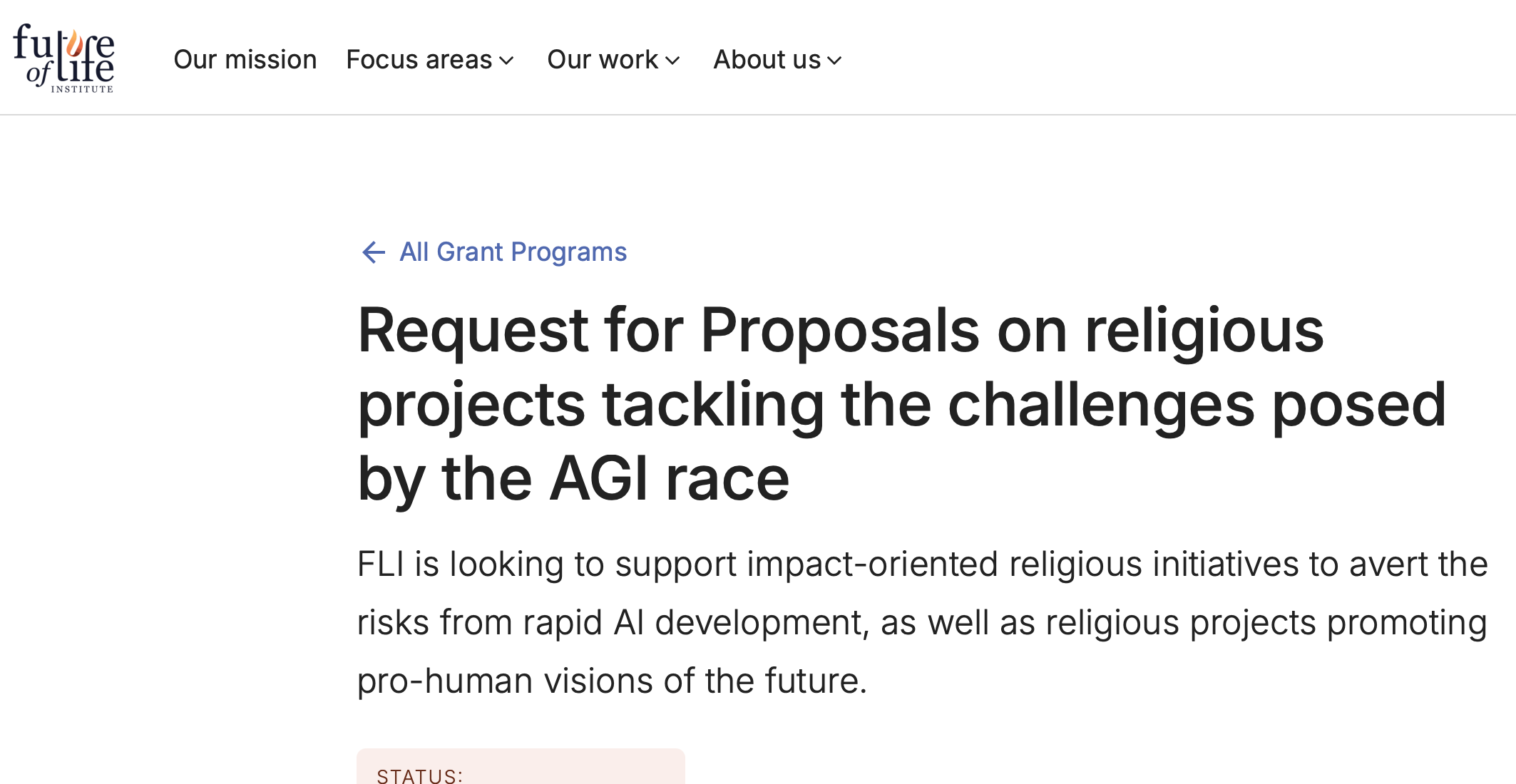
The Future of Life Institute — the EA-aligned leftist nonprofit best known for its ruthless insistence that America must force industry to “pause AI” indefinitely — has launched a formal grant program targeting religious organizations across every major faith tradition. The program, titled “Request for Proposals on religious projects tackling the challenges posed by the AGI race,” offers individual grants of $30,000 to $300,000, with a stated mission to recruit faith communities into “the fight for a positive AI future.” Of course, this involves aligning with the group’s preferred framing for its longstanding campaign to slow innovation in AI through crushing regulation and attempts at creating institutional paralysis.
That the Future of Life Institute is writing checks to clergy deserves a moment of reflection. The EA movement that bankrolls FLI is not known for its religiosity, to put it mildly. It is a community built around utilitarians and secular technocrats who have more in common with Code Pink organizers than with any churchgoer. Some of its most prominent figures have been associated with the polyamorous “rationalist” subculture of the Bay Area. It’s fair to say that it’s a social scene not typically found in the front pews of evangelical megachurches or LDS wards. The EA ecosystem produced Sam Bankman-Fried, not Billy Graham. That these same networks are now presenting themselves as natural partners to faith communities should raise an obvious question: is any of this genuine, or is it simply the most politically useful audience left to capture?
Utah has been a primary target for AI Doomer infiltration, as this publication has previously reported, though the “faith” campaign extends far beyond the state.
FLI’s religions initiative spans every major denomination and multiple continents.
On the Catholic front, FLI president Max Tegmark appeared at the Vatican’s Pontifical Academy for Science in October 2024, arguing the Church should draw a moral line against “the hubristic pursuit of a digital god AGI.”

In the LDS church, Elder Gerrit W. Gong partnered with EA-linked groups and delivered a speech in October of 2025 invoking “effective altruism” as the height of morality.
“Profit-driven technology companies should not be determining society’s AI moral compass,” Gong said. “We still need effective altruism. We need care and caution to forestall unforeseen and unintended AI consequences.”
On the evangelical front, the May 2025 open letter to President Trump signed by Reverends Johnnie Moore and Samuel Rodriguez — framed as an organic expression of Christian concern about AI — was noticeably distributed to journalists by Future of Life Institute representatives. Days later, FLI founder and president Max Tegmark shared a panel with Moore at Catholic University of America, with FLI listed as a Platinum Sponsor of the conference.

Beyond Christianity, FLI has funded the Buddhism & AI Initiative, the Nigerian Religious Coalition on AI, a Muslim-Christian coalition framed around resisting the “harms” of rapid AI development, and has even published Islamic perspectives on AI arguing that a positive future is one where individuals can “say no” to AI integration at every level of society. The theological packaging varies entirely by audience, but it all serves the Doomer agenda.
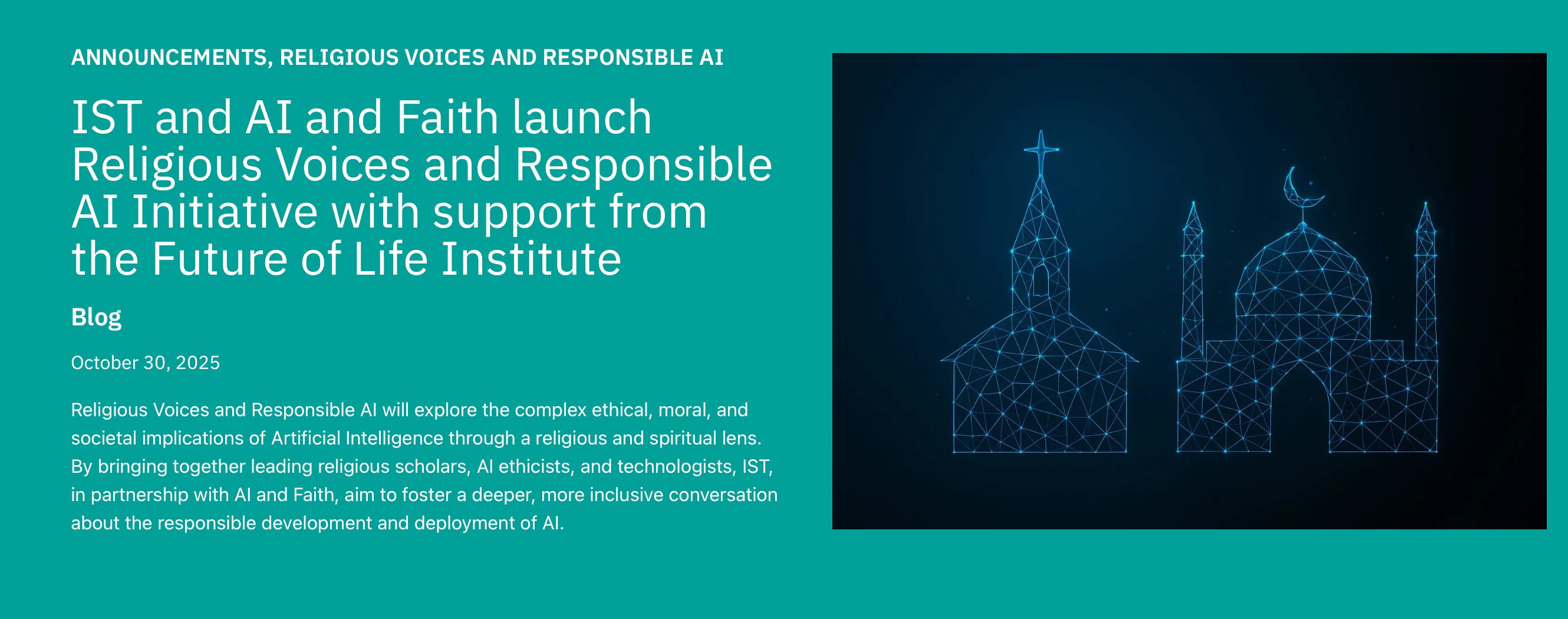
The infrastructure layer is particularly revealing. In October 2025, The Institute for Security and Technology and a group called AI and Faith, with direct FLI funding, launched a “Religious Voices and Responsible AI” initiative explicitly designed to develop curricula and resources equipping pastors, imams, and religious educators to engage AI governance.
In addition to their well funded machine in D.C., EA-aligned groups have spread funding and resources far and wide to distribute seminary-level indoctrination, now rapidly building the institutional capacity to sustain AI Doomerism to faith groups.
As The Dossier has previously reported, the same funding stack runs beneath nearly all of the astroturf. Americans for Responsible Innovation, a group bankrolled by Coefficient Giving (Facebook cofounder Dustin Moskovitz’s giving vehicle), has acknowledged its mission has been directly boosted by the escalating outspokenness of faith leaders. ARI’s vice president of communications said so on record. In November 2025, a coalition of 43 faith leaders sent a letter to Congress opposing AI law preemption in the NDAA, a precisely targeted legislative priority of the EA-aligned governance apparatus. The National Association of Evangelicals separately urged the House to restrict AI chatbots. These letters present as grassroots moral witness, but they arrive at Capitol Hill coordinated with the same organizations, funded by the same donors, and hitting the same policy targets.
The AI Safety Racket: How Leftist Activists Use Children to Smuggle AI Regulation into Red States

The playbook is demonstrating a consistent pattern in states across America: find Republican officials and legislators who are skeptical of AI, frame the regulation around children, commission polling, hire local Republican credibility, and move fast before the funding sources become the story.
The sum of money being deployed here is not trivial. EA-aligned entities are spending hundreds of millions, if not billions of dollars, to deliver political results and cultural change. The faith outreach is another powerful means to pursue EA’s anti-innovation degrowth agenda through America’s institutions.
There is a remarkable paradox at the center of the enterprise. The same ideological community that produced effective altruism’s most notorious scandals is now presenting itself as a defender of religious communities against concentrated technological power. These are the leftist utilitarian hardline ideas that justified fraud, spawned Bay Area social arrangements that would scandalize any traditional congregation, and comes with an explicit goal of using concentrated wealth to impose preferred outcomes on the rest of humanity. For faith leaders, before they take the money for the next renovation, they might first want to ask their new AI policy “partners” what they actually believe in.
Some won’t notice the disconnect. Institutional prestige and grant funding have a way of smoothing over inconvenient questions about alignment and shared ideas. But the pattern is legible for anyone willing to look. EA-linked organizations are not partnering with faith groups because they share their values. They are partnering with faith groups because they have moral credibility with large swaths of the American public, and the EA-aligned actors hope it will help to launder their agenda through the pulpit.
I would not interpret the words of Elder Gong as anti AI. The LDS church is highly invested in AI. Data archiving, management and mining has always been a priority for the church. AI is perfect sauce to add to the existing software capabilities.
What concerns LDS leaders is AI being used to challenge the church and its leaders and standing. This is the same concern government leaders have. Everyone in an establishment position is worried of the powers of AI to persuade people to distrust them.
And frankly, we all should be worried about AI being used to manipulate minds. This does not mean censorship is the solution. It does invite consideration of regulations that inform people that what they are seeing is fake and artificial. I suppose that real actual politicians lying and misleading is OK, but enabling mass production of fake & artificial lying politicians is too much!
I despise the left but "AI uber alles" is NOT a popular position.
Data centers driving up home energy costs is WILDLY unpopular.
If you have anything other than a very basic problem or inquiry, AI customer service chatbots suuuuuuuuck. Comcast's reset protocol for cable is the worst of the bunch. Trying to cancel a subscription like SiriusXM without being rude is damned near impossible.
Finally they still are bad at context, nuance, or even basic math. Google's AI assist tried to pin 3/4 of the year 2026 at 6 AM, but clearly it's 6 PM (if on standard time, that is). I called it out, it said I was right, then regurgitated 6AM.
It does some neat tricks, but I believe companies are very unwise to throw their lot in with AI as the be-all, end-all. It's a bland world and while I'm not against AI, I think it's rather overhyped. Especially with mainstream media pushing it -- so you should KNOW there is an agenda afoot in there somewhere.