

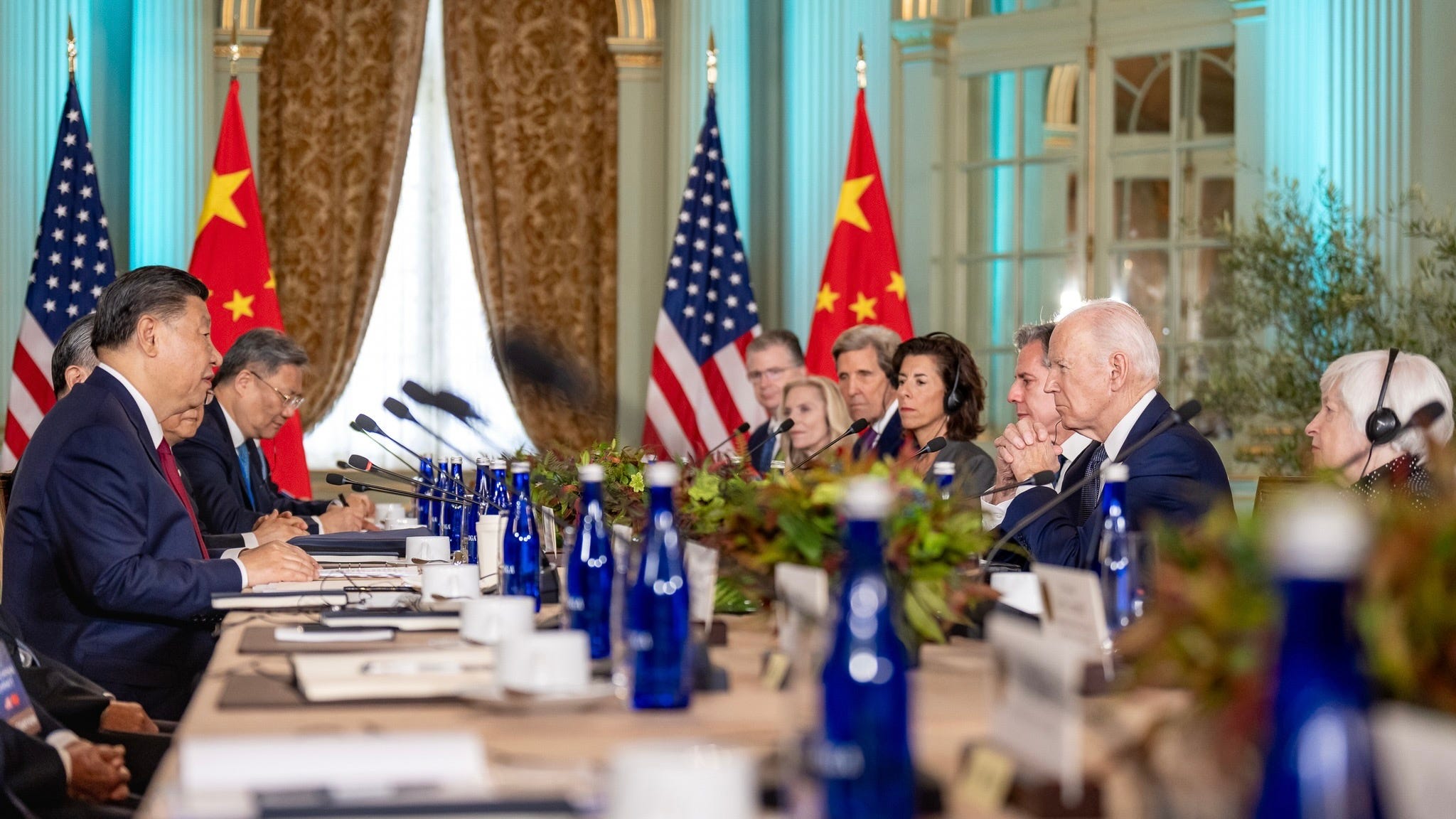
In 2022, the Biden administration unveiled its signature tech policy: a sweeping set of export controls designed to choke off China’s access to advanced AI chips. The goal, at least on paper, was to preserve America’s qualitative advantage in Artificial Intelligence specifically by keeping the most powerful processors engineered by Nvidia, the indispensable flagship American AI company, out of Chinese data centers.
Four years later, the results are in.
Huawei, a key instrument for the Chinese Communist Party’s global tech ambitions, expects $12 billion in AI chip revenue this year, up from $7.5 billion in 2025. That’s a whopping 60-plus percent year-over-year growth, with orders already locked in from Chinese tech giants Alibaba, ByteDance, and Tencent. Nvidia’s market share in China? Its founder and longtime CEO Jensen Huang told an interviewer last month that it has fallen to zero. Yes, zero. “Nvidia had … 90-some odd percent of the world’s market share,” Huang said in the interview. “Today, in China, we have now dropped to zero.”
Another major American AI hardware and software company finds itself facing similar issues with global competitiveness. AMD makes a performance-capped chip designed specifically for the Chinese market because the chip is deliberately neutered to fall under export thresholds. AMD has been allowed to keep shipping into China, but the structure of the deal is itself is a mess. AMD is being permitted to occupy a small piece of the market that Beijing has not yet decided to close. It’s the same tier Nvidia briefly held with similar chips before Chinese regulators began pressuring buyers to refuse it.
And some members of Congress are making all of this worse. In April, a group of House lawmakers introduced the MATCH Act, which would follow the same aforementioned path to tightly control the export of chipmaking machines made by the Dutch firm ASML. The bill goes a step further than past rules: it would also stop ASML and big time American firms like Lam Research and Applied Materials from servicing the machines already installed in factories abroad. Some voices in Congress are not just trying to block new sales, but hoping to break down the supply chain entirely. Like its peers, ASML's China revenue has already collapsed from more than a third of its quarterly sales late last year to under a fifth this spring, and the MATCH Act would push it lower still. The MATCH Act, ostensibly written to slow China’s ambitions, will instead pay for it, and the bill will be paid by mostly American companies whose grip on Asia acted as a major piece of leverage against our adversaries.

So is America winning?
Unfortunately, the policies that are being promoted to handicap China’s AI ambitions instead handed Huawei the largest captive market in the world and forced some of the world’s most talented engineers to do exactly what Washington wanted to avoid most: China is building a credible domestic alternative to the American AI stack.
To understand why this matters, you have to understand how AI ecosystems work.
When a frontier AI model is built (think ChatGPT, Claude, Gemini, etc), its developers don’t just write code that runs on whatever hardware happens to be lying around. They optimize for a very specific, non swappable chip architecture. That optimization extends to the surrounding software, which involves the “stack” that turns metalloids into an entire AI system.
Nvidia’s edge over the past decade has not been chips alone. It has been CUDA, the software platform that hundreds of thousands of engineers know how to use and have built atop. Once your AI model is tuned for CUDA, every downstream piece of infrastructure comes with it. You cannot simply unplug any Nvidia GPU and replace it with a Huawei processor. The whole model has to be rebuilt and recalibrated for its engine. A switch would mean that the whole team has to be retrained and the whole ecosystem has to be migrated.
This is precisely what just happened in China, but in the wrong direction.
In April, the Chinese AI startup DeepSeek released its V4 model, an advanced system optimized not for CUDA but for Huawei’s CANN system. Their engineers worked directly with Huawei before launch, and reportedly, did not extend the same early access to Nvidia or AMD. Chinese tech giants Alibaba and Tencent deployed V4 services within hours of release.
Once Chinese cloud providers built their infrastructure around Huawei’s hardware and software, the cost of switching back to Nvidia became prohibitive. Huawei now reports more than four million developers on its CANN platform. Three years ago, that number was effectively zero.
Nvidia’s latest annual filing concedes what its founder has publicly stated, that the company is “effectively foreclosed from competing in China’s data center computing/compute market” and is booking no revenue from the broader region in its current outlook. Analysts project Nvidia’s share of China’s AI GPU market will settle around 8 percent or less in the coming years, down from 66 percent in 2024.
The AI race is a global contest. Every country is now trying to build serious AI capacity in some form. These countries now face a choice that did not meaningfully exist only two years ago. Huawei has been actively pitching Ascend chips and remote access to its CloudMatrix systems to Gulf states and Southeast Asia, while Washington’s tiered framework, which placed even close allies like Israel and India behind chip caps, pushed those governments to take the calls from our foremost adversary. If Riyadh’s national AI infrastructure or Jakarta’s data centers get built on Ascend silicon and CANN software, they will not be migrated back to American hardware in the next decade. Network territory generally works the same way everywhere: the tech stack that arrives first is usually the only one that stays, because swapping out and retraining is both cost prohibitive and burdensome on governments, bureaucracies, and private customers.
The strategic logic of America’s chip war assumed that China could not build its own alternative quickly enough to matter. That assumption is now being proven as incorrect. Huawei has rolled out its own high-bandwidth memory chips and Beijing is pushing for 70 percent domestic silicon wafer use. A fully integrated Chinese AI stack is no longer a hypothetical, but a very clear reality that we confront in our geopolitical decisionmaking today.
There is a lesson here that goes beyond one White House administration. America’s technological dominance is fueled by a system that leans into free enterprise and our founding ideals. It has never rested on what it forbids others from doing. It has rested on what its ecosystem makes irresistible to use. When the world’s developers build on American platforms, American influence compounds, not just commercially, but strategically. Of course, our most prestigious technology companies do not perfectly represent American domestic and national security interests, but they do so far more accurately than a Chinese counterpart ever will.
The Biden Administration’s export controls did the opposite of their intended effect. It spawned a domestic powerhouse industry within our adversary that will now seek to deploy its technology globally.
The Trump administration has signaled a willingness to revisit elements of Biden-era chip policy. It should. The question is no longer whether to slow China. Winning the AI race means allowing American companies, as mighty but imperfect extensions of American power, to be given the freedom to compete and win globally.
This is what happens when you let the Government decide the rules instead of letting the free enterprise of Capitalism innovate for the USA..
Also, everyone in Congress is bought and sold and will always follow the money instead of Loyalty to America and Americans
Smh
We are afflicted with morons.