

All too often these days, you reach the end of an article in the corporate media, some piece about the perils of artificial intelligence in a publication you have trusted for years, and find yourself greeted by a curious little line of text: “This story was supported by a grant from the Tarbell Center for AI Journalism.” Most readers scroll right past it, and that is rather the point. They have never heard of the Tarbell Center, and they certainly do not know what it wants. It presents itself as a benign charitable outfit that hands money to reporters covering AI, a generous patron of public-interest journalism in a brutal media economy. What it actually amounts to is a funding pipeline that purposefully shapes how the nation’s most influential newsrooms cover the most consequential technology of our time.
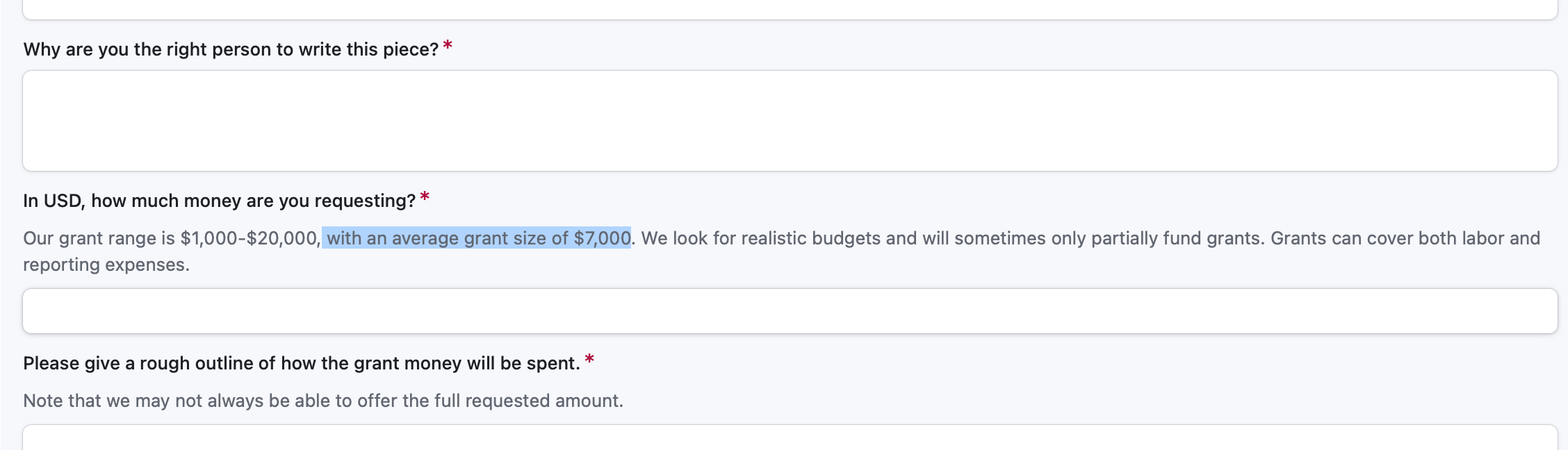
And it is generous indeed. By its own public accounting, the Tarbell Center is paying working journalists an average of better than $7,600 for every single article it bankrolls, with individual grants running as high as twenty thousand dollars a story. That kind of money buys the sort of artificial intelligence coverage that treats the most promising technology of our lifetimes as a slow-motion apocalypse. If you have ever wondered why so much of the corporate press covers AI like a horror film rather than an industrial revolution, the Tarbell-media stenographer pipeline makes sense of that dilemma.
This is no one-off arrangement. Tarbell runs an ongoing fellowship that embeds its hand-picked, salary-funded reporters directly inside the nation's most influential newsrooms, where they work the AI beat from the inside for up to two years. Its fellows have been placed at the Los Angeles Times, NBC News, Bloomberg, TIME, The Guardian, The Verge, MIT Technology Review, The Information, the South China Morning Post, among others.

So who is signing those checks? Follow the money up the chain and you arrive at a left-wing tech billionaire. Surprise! Tarbell’s funding flows in significant part from Open Philanthropy, the sprawling Effective Altruist-aligned grantmaking machine recently rebranded as Coefficient Giving, which exists to deploy the fortune of Facebook co-founder Dustin Moskovitz and his wife Cari Tuna. Moskovitz is no quiet, apolitical philanthropist tinkering at the margins of public life. He is one of the largest Democratic megadonors in the entire country, a man who poured around twenty million dollars into electing Hillary Clinton, tens of millions more into defeating Donald Trump and installing Joe Biden, and who by 2022 had routed better than seventy million dollars into Democrat-aligned political machinery. In 2024 he was reported to be the single biggest tech-founder donor to Kamala Harris. This is the man whose philanthropic empire quietly underwrites a meaningful share of what your morning paper tells you about artificial intelligence.
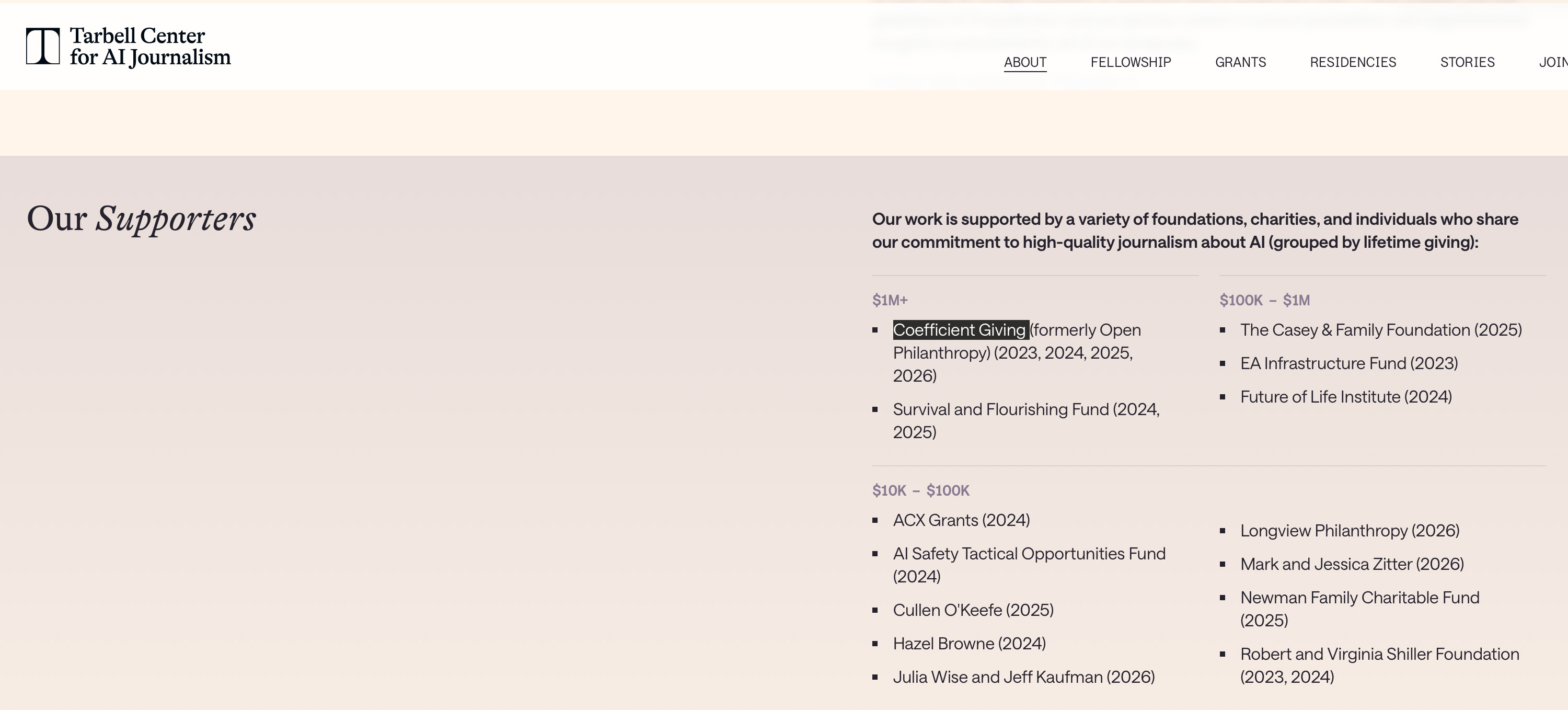
The worldview that empire is buying is not the neutral, public-spirited “AI safety” that Tarbell advertises. Strip away the language about supposedly helping society “navigate advanced AI” and what you are left with is pure doomerism. We are left with the conviction that AI is less an engine of prosperity than an existential menace that must be slowed, regulated to death, and consumed by the state, with a policy emphasis on the latter two objectives, given that Moskowitz is a major shareholder in Anthropic, which seeks an impenetrable regulatory moat in D.C. This is a degrowth and anti-competitive ideology aimed squarely at a single industry, the insistence that AI is a thing to be feared and contained rather than unleashed broadly and fairly for the benefit of ordinary Americans.
Moskovitz related entitites bankroll several of the think tanks that draft the regulations and the policy shops that lobby for control, and it now helps fund the journalists who cover the whole apparatus.
Tarbell insists that none of this money touches the journalism itself. Its favorite phrase on its website is editorial independence. The donors have no involvement, it assures us. An independent panel of judges scores the applications. Staff never see or shape a story before publication, and every funded piece carries a tidy little disclosure line buried at the bottom.
But notice what that very defense quietly concedes. There is a committee. Tarbell says so itself, in plain language: applications are judged by a panel, and when the judges disagree, Tarbell’s own staff make the final call on who gets paid and who walks away empty-handed. An organization that decides which pitches are worth thousands of dollars and which are worth nothing is exercising editorial power of the most consequential sort, and it is doing so before a single word has been published. You never have to editorialize a reporter’s copy when you get to choose which reporters are funded to file in the first place. The selection bias and the selection criteria sit in plain view on Tarbell’s own website, nudging applicants toward the safety pledges, the “dangerous capabilities,” and the corporate villainy that the doomer movement is most eager to see splashed across the internet.
This is how narrative engineering operates in the current era.. There is no public online memo that sleuths can dig up to show specific orders to the reporters Tarbell supports. Yet there is a grant program, a prestigious fellowship, a generous stipend, and an assignment desk with charity window dressing. All of it is purposed with steering some of the nation’s most influential newsrooms in a direction chosen by a handful of ideologically committed individuals. The reader who sees an LA Times, NBC News, Bloomberg, Guardian or WIRED byline has no way of knowing that the story exists at all because a Democratic megadonor’s foundation decided it was worth paying for.
None of this involves a smoke-filled room or a secret handshake. It requires only money, groups of deployed ideologues, and a firm editorial sense of which stories advance the cause. He who pays for the beat will, given enough time, shape the beat. This is not an act of charity. It’s an influence operation designed to achieve the objectives of the AI panic camp.
They've seen that climate doomstering is coming to an end, so they're looking for the next profitable schtick….
How much of this kind of influence peddling is going on in other realms as well.